I do not post very often to this blog, so if you are interested in geoscience then please see
Ron Schott's comprehensive list of geoscience blogs that is frequently updated.
http://ron.outcrop.org/blog/?page_id=716
Wednesday, February 01, 2012


Sunday, December 21, 2008
Pope praises Galileo's astronomy
Pope Benedict XVI has paid tribute to 17th-Century astronomer Galileo Galilei, whose scientific theories once drew the wrath of the Catholic Church. BBC NEWS
It has been nearly 400 years since the papal trial in which he was found vehemently suspect of heresy for his teaching of the heliocentric theory. Galileo was then placed under house arrest and his movements restricted by Pope Urban VIII.
I am delighted that the current pope has seen fit to acknowledge the truth of Galileo’s observations and his accounts thereof. But I can only wonder how many more years it will require for the Catholic Church and the other religions of the world to acknowledge that God is a myth.
"There are no gods, no devils, no angels, no heaven or hell."
"There is only our natural world."
"Religion is but myth and superstition that hardens hearts and enslaves minds."
Freedom From Religion Foundation
Sunday, November 09, 2008
Anthropomorphism
Anthropomorphism is the attribution of human motivation, characteristics, or behavior to inanimate objects, animals, or natural phenomena.
In my mind this is a form of insanity in the modern world and a total denial of all the knowledge that homo sapiens have acquired in the past 30,000 or so years. I can accept that poets and writers use the concept for the entertainment of their reader, but the reader, except for a rare few, rarely goes away believing that rocks can think a believer.
I say rarely, because I just received my current AARP Magazine where I found this letter to the magazine.
Sinking Ship
I was on the National Geographic Endeavour, one of the two ships that steamed to the rescue of the sinking M.S. Explorer [“Mayday in the Antarctic”]. Our captain remarked that the Explorer, nearing its final voyage, may have chosen to remain in those waters, and selected that moment, when its passengers could be rescued, to end its historic life. To those of us who witnesses this event, this actually seemed possible. John Curtis, Heath Texas
This one stopped me in my tracks because it is pure Cro-Magnon insanity:
- That the captain of a scientific research vessel, someone that should have both knowledge of and respect for science rather than some strange mysticism, ascribed multiple human traits to an object.
- He said that the ship made an intellectual choice to sink rather than complete its voyage.
- He implied that the ship felt compassion towards its passengers and made a deliberate choice to sink where they could be saved.
- That someone, anyone, that heard those remarks would go away believing this strange mysticism, and repeat it and their belief in it, especially in a magazine that prides itself on providing their members with the facts and rational thinking they need to understand and deal with our modern society.
- That the editors of AARP Magazine, from the hundreds of letters they receive from their readers, many of them probably filled with facts and rational thinking, selected that letter to print and promulgate this strange mysticism.
To me, a science oriented atheist, this is how religion got started. Humans, unable to understand the world around them, used anthropomorphic concepts to explain their world. Gradually they expanded their explanation to mysticism and gods of many kinds. Then when some humans realized that they could profit from the Cro-Magnon beliefs of their fellow humans, priests were born and modern humans have been plagued ever since.
Perhaps, for the Cro-Magnons still among us, the captain of the National Geographic Endeavour just became a priest of a new religion, Mr. Curtis his first apostle, and the letter to AARP will become their first epistle.
I really don’t mean to denigrate the Cro-Magnons of thousands of years ago, just those among us that have never evolved any further.
Thursday, October 23, 2008
X-rays detected from Scotch tape
Just two weeks after a Nobel Prize highlighted theoretical work on subatomic particles, physicists are announcing a startling discovery about a much more familiar form of matter: Scotch tape. It turns out that if you peel the popular adhesive tape off its roll in a vacuum chamber, it emits X-rays. The researchers even made an X-ray image of one of their fingers. Yahoo! News
I love this story. By itself it answers the myriad of questions, the cartoons, the snide letters-to-the-editor, and associated rants from all those whose knowledge of science is limited to how to dial a telephone. “Why”, they will ask about a particular research project, does the government fund such stupidity (their words).
And for the answer we can now refer them to this article. Someone, not a researcher, must have criticized the researchers for even considering such an experiment. “A waste of funds” or some other snide comment. The truth they needed to be told, is that knowledge and the discovery of new information is never a waste. All those that rail against scientific research, and especially research that on the surface appears meaningless need to understand this truth.
Today, the knowledge gained from this experiment may seem of little use. But other researchers will extend and amplify this knowledge and one day there will be a significant benefit that will be derived from it. It may not even be in the areas highlighted by the article but in an entirely different and unpredicted area. That is what science and research are all about and I believe this is a great example.
Sunday, June 29, 2008
What will the Scientific Community do?
CHICAGO, June 28 (UPI) -- The Field Museum in Chicago said a massive study of bird genetics has completely redrawn the avian evolutionary tree.
"The results of the study are so broad that the scientific names of dozens of birds will have to be changed, and biology textbooks and bird watchers' field guides will have to be revised," The Field Museum said Thursday in a release.
An international research team spent more than five years examining DNA from all major living groups of birds. The findings are published in the journal Science.
The study found that colorful hummingbirds evolved from drab nocturnal nightjars, falcons are not closely related to hawks and eagles and tropicbirds are not closely related to pelicans and other water birds.
"Our study and the remarkable new understanding of the evolutionary relationships of birds that it affords was possible only because of the technological advances of the last few years that have enabled us to sample larger portions of genomes," said Shannon Hackett, associate curator of birds at The Field Museum. DNA study shakes up bird family tree - UPI.com
What they will do is what separates science from religion. The scientific community will completely rewrite all of the material and scientists will completely revise their thinking and their teaching to agree with this new and remarkable data. Oh, there will be individual scientists that will refuse to let go of the traditional dogma, but the bulk of scientific community will change almost overnight.
On the other hand we have seen no religion do that in spite of the overwhelming evidence that human DNA and animal DNA are identical in some areas. The major religions still contend that humans were created by their god in the image of that god. Oh, there are individual religious “leaders” that have let go of some of the traditional dogma, but the massive bulk of the religious community steadfastly clings to archaic and superstitious drivel from the dark ages.
Update
Allow me to refer you to a wonderful example of this. Please see the post by biologist P Z Myers, and the comment too, at: http://scienceblogs.com/pharyngula/2008/12/amylase_and_human_evolution.php
Friday, April 25, 2008
Reaching the Stars
Humans need to realize that for the foreseeable future we are stuck on our planet and we can not soon leave it. A better way to recognize this is to look at the numbers.
The stars that are nearest to our sun are about 4.4 light years away from us. That is over 25 trillion miles away.
Traveling at a million miles an hour that would take almost 26 million years for a group of human colonists to get there. To get there in just one thousand years would require an average speed of 26 billion miles an hour. To protect the human inhabitants, the colony ship would have to speed up and then slow down in an orderly fashion. Consequently the maximum speed the ship reached would have to be far greater. Needless to say, we have not yet achieved the million mile an hour speed.
Another issue is that, even if the colony ship could attain the necessary speed, one thousand years is around 35 to 40 generations of humans living and dying aboard our spacecraft. Assuming that the colony ship would be equipped to support these generations of humans, think of all that has occurred here on Earth in the last thousand years and you can well imagine that the social problems those colonists would face.
Even more of an issue is that only 3 stars are even as close as 4.4 light years from us. None of these seem to have habitable planets. Even if we expand out to 25 light years from Earth, perhaps only a dozen star systems may possibly be capable of hosting Earth type planets in stable orbits within their habitable zones. This means that there still may be no habitable planets within 25 light years of Earth.
I am not optimistic that humans will soon colonize our galaxy. The massive technological, social and political issues with exploration and colonization that confront us are beyond daunting. However, I envision that our robotic surrogates can and will do our exploring for us.
I suggest that we humans must develop machines that will venture beyond our solar system and travel out into the galaxy. These machines would be self-sustaining, capable of self repair and self replication. When each machine locates an appropriate object - planet, moon, asteroid, etc - it would be capable of safely landing on the object and then it would proceed to mine the object for materials to replenish and repair itself and construct clones of itself. Each clone would be launched in into a different part of the galaxy where it would repeat the process of exploration and cloning.
All of these machines would have the capability of maintaining contact with each other and humans here on earth. They would collect and transmit data about their journey and a huge database of information would be amassed for our use. At the same time a huge network surrounding our solar system would develop and expand.
Then many millennia from now perhaps humans will have solved all of our technological, social and political problems and be well prepared to venture out into space. The information gathered by these explorer robots would be invaluable to determining destinations for our colonists and provide a communication network for them and their descendants.
Saturday, March 29, 2008
The Expanding Universe: A Theory
Technorati tags: dark energy, dark matter, expanding universe, universe, black holes, stars, super novas, pulsars, solar wind, gamma ray bursts, grb's, Cosmology
Dark Energy and Dark Matter
The universe is a violent place and energy abounds in it. Huge amounts of matter are continuously expelled from stars and other objects. Massive solar flares add to the great volumes of matter hurling out into space in the form of solar winds. Super Novas, gamma ray bursts, pulsars, and black holes generate enormous amounts of matter and energy and that energy radiates out from each and every galaxy in the universe; this is the intergalactic wind. In the vast regions between galaxies the intergalactic wind flows unimpeded toward the next galaxy with constant and great amount of force.
Consequently when the intergalactic wind encounters another galaxy it exerts pressure on that galaxy. From all parts of the universe each galaxy is receiving pressure from the intergalactic winds pummeling it. Were the universe somehow bounded or if there were an endless array of galaxies everywhere in an unbounded universe, the pressure of the intergalactic wind would have little or no impact on any galaxy. It would all balance out.
However the universe is not bounded and out there somewhere, in a place we are poised on finding, there are no more galaxies. At some point we will find galaxies that beyond which there is simply nothing.
These outermost galaxies at the edge of the universe receive the constant pressure of the intergalactic wind exerted only on one side. There is no pressure being exerted on the opposite side of these galaxies. Over time then, gradually each of these outermost galaxies will slowly be moved by the wind out into the vast nothingness that borders them.
In this manner, the extent of the entire universe expands. Further, toward the center of the universe, there is a lighter pressure of the intergalactic wind coming from the edge of the universe with its lesser concentration of galaxies. Thus all of the interior galaxies of the universe will slowly migrate outward in the direction of the lesser pressure. Hence the space between all galaxies expands.
As each galaxy moves a greater distance from its neighbors there is a lessening in the gravitational attraction between galaxies. Because of this reduction in the gravitational attraction felt by adjacent galaxies and because no new matter is being created in the universe, the expansion between galaxies will accelerate as the physical size of the populated universe expands and occupies more and more of the emptiness around it.
However, stars within a galaxy as well as local groups of galaxies that are bound by their mutual gravitation will not expand. They will continue to remain much the same size as we find them today.
Friday, June 15, 2007
I Have A Rock
When I travel, I often grab a rock, any rock, from that place. Here is a map of the U. S. showing, in red, all of the states I have visited. I probably collected a rock from each and tossed it into the rock pile at home. Some geologist would go nuts looking through that pile.
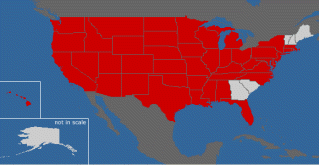
create your own visited states map
Wednesday, April 11, 2007
My Brain is Scientific - Yours is ?
Scientific thinking, education, common sense, and any other rational thinking process will never be able to overcome the lack of thought I see in people of faith.
People of faith do not actually need to think, they "believe" and that is enough for them. Because they believe, then all of the facts and data that humans have available to us are meaningless to them. This information is as useless to them as it would be to a sea slug. (Sorry sea slugs.)
What a bizarre world it must be to them. Every day they are presented with huge amounts of scientific information. Some of this information may be of value to them in their lives or profession, so they assimilate this while all of the rest must be discarded. I can only imagine that their brain has a kind of filter, much like our email systems do, that sifts out irrelevant, to them, information before it can enter any actual thinking process.
If "belief" were the only issue, then rational people, scientific thinking people, and other non-believers would probably ignore the stupidity that accompanies belief. But "belief" is not the real issue. Believers also believe that scientific thinking is not to be tolerated. Their cause is to dominate and control the lives of others. Their goal is to determine the reality that the rest of us live in.
They would never have an abortion, except when they decide it is okay for them, therefor they will outlaw abortion for everyone. They approve of "under God" to be included in the American Pledge of Allegiance, so they enact the law requiring it there. They proudly proclaim their full, complete and unfettered support for the U. S. Constitution, and then decide to amend it willy nilly. Remember prohibition?
Regardless of religion, ethnicity, and sex these people are everywhere, and they want to govern your lives. The nice old lady, in her house of worship, is a very dangerous person. Her pronouncements of right, wrong and what is truth are not based on anything other that her beliefs. Facts and consideration for others do not deter her. When we see young people throwing their and other lives away, remember they were influenced by sweet old granny.
It is not absurd to think that "believers" can and will believe in the most idiotic ideas around. There are people that believe that the world is flat and you can not convince them otherwise. I know someone that firmly believes that no human ever went to the moon and that all of NASA's scientific discoveries about space are a hoax.
When "believers" are just ordinary citizens, they do not present much of a risk to the rest of us. But when they have, money and positions of power and influence, they are a threat to our liberty, freedom and to human progress.
Example? You would like a couple of examples? Okay - try these:
- An educated idiot with some influence and a forum.
- A really well educated idiot with seemingly impeccable credentials.
I can not imagine how people, like these, trained in the sciences can reject scientific method, practice and the wealth of evidence so easily in support of a "belief". It does seem that much of the thinking of the "dark ages" is still with us.
Tuesday, March 13, 2007
Tectonic Plates and an Underwater Volcano
Because of my affection for rocks, I have closely followed the discoveries associated with Tectonic Plate Theory. But when I moved to the Pacific Northwest, I quickly became much more aware of the jumble of plates and tectonic processes that exist here. I am not a scientist, but try to understand what is going on under our feet. Like geology, I enjoy history too and geology is another form of history. In both cases I am really bad on dates.
The offshore area of the Pacific Northwest is a complex area of tectonic plates. In this relatively small area there are many laboratories for scientists to study and understand the tectonic wonders of our planet. We non-scientists have come to know about these wonders because of their impact on our lives.
Located approximately 300 miles west of Cannon Beach, Oregon is the Axial seamount. It is a broad volcano about 12 by 18 miles with a summit caldera and two rift zones. Much like the Hawaiian volcanoes it is the product of a hot spot. Over 2/3 of a mile in height, it is still nearly a mile below the surface of the ocean.
Axial, sits on the volcanic Gorda Ridge, an undersea formation that is a cousin to the Mid Atlantic Ridge. Gorda Ridge runs somewhat parallel to the coast in a north-south direction off Southern Oregon and Northern California. Similar to the Juan de Fuca Ridge farther north off the Northern Oregon and Washington coasts, the Gorda Ridge is a spreading center where molten lava oozes onto the sea floor to form new oceanic crust.
The Juan de Fuca Plate plunges deep beneath the North American Plate and is the source of the Cascade Range of volcanoes above the subduction zone. To the west along the boundary between the Pacific and Juan de Fuca Plates is a broad submarine mountain chain about 500 kilometers long. This is the Juan de Fuca Ridge. Here are a series of young volcanoes, lava flows, and hot springs in a broad valley less than 8 kilometers wide along the crest of the ridge. At the north end of the ridge is the small platelet named the Explorer Plate and at the southern end is the Gorda Plate.
The Juan de Fuca Ridge, only about 200 miles (300 km) west of the state of Washington, is perhaps the most studied ridge with a medium spreading rate. The Juan de Fuca Ridge creates part of the Pacific plate and all of the Juan de Fuca plate.
The hot springs found in the valley are home to amazing creatures that scientists are fascinated with. And for good reasons too. One of them is a heat-loving creature capable of fixing nitrogen at a amazingly hot 198 degrees Fahrenheit. It may be related to our Earth’s earliest organisms capable of nitrogen fixation. These hot springs result in beautiful tall chimneys as Axial Volcano vents dense mineral hot hydrothermal fluids. Regardless of the total darkness here, colonies of bacteria thrive as they feeding on the chemicals. Magically, tube worms arrive as if from nowhere.
Friday, December 29, 2006
Columbia River Basalts
About 5 to 25 million years ago one of the largest flood basalts ever to occur on earth happened in the Pacific Northwest. These flood basalts spread across what is now Oregon, Washington and Idaho. There have been arguments that they even extended into far northern California and Nevada. In either case, they were huge and cover about 63,000 square miles. Scientific analysis of Argon and Potassium in these basalts indicate that the largest eruptions were from 17-14 million years ago and to a lesser extent from 14-6 million years ago.
The estimated volume of these basalt floods is over 41,500 cubic miles. While this is very large in human terms, it is not so in geological terms. It would take over 12,500 of these floods to equal the volume of the moon.
Here is a map from the Large Igneous Province Commission that shows the extent of these floods. The asterisks on the map show the location of the Cascade volcanos.
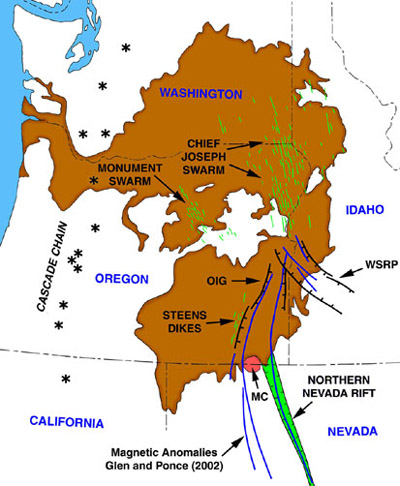
I first saw some of the features of this great province on a trip from near the California and Oregon border up Highway 395 on my way to Golden, Alberta, Canada. About 30 miles north of Lakeview, Oregon is Abert Rim and Lake. John Fremont discovered Abert Rim and Lake on December 20, 1843 and named it for his commanding officer The rim rises about 2,500 feet above the valley floor and can be seen for about 30 miles. Below it is one of the largest lakes in Oregon. I was totally fascinated by the view into earth's geologic past. The top 500-600 feet of the rim are almost vertical and the huge basalt cap of the rim is clearly evident. Here are two photos I took at the time.
Abert Rim 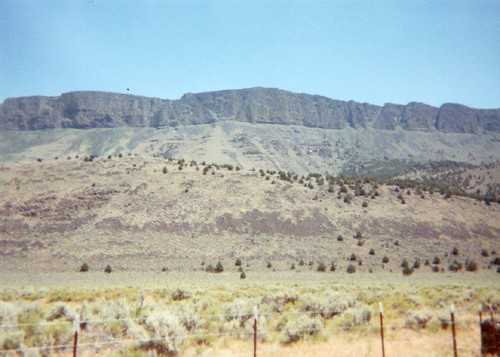
Abert Lake and Rim 
Technorati tags: Geology, flood basalts
Monday, December 11, 2006
Geodes in Keokuk Iowa
In the 70's my wife, Anita, and I took a long 4th of July weekend and drove down to Keokuk Iowa. We were going to find geodes. Actually, we never looked for them in Iowa. We stayed at a motel there and used it as our base for this adventure. We had been advised that when it came time to go looking and collecting, we should go across the river to Hamilton Illinois.
A fellow rock hound had advised us of a gravel quarry near Hamilton that would be a great collecting site. After asking directions locally, we crossed over the river and found the quarry.
It was the 4th and no one was at the quarry. It was deserted and there were no signs telling us to stay out, so Anita wrote a note and left it on the gate thanking them for allowing us in and left our names.
I had two strong cardboard boxes that once had held reams of copy machine paper. We dragged them down into the quarry and began searching. It was a geode hunters paradise. They were everywhere. All we had to do was to remove them from the dirt walls of the quarry. After a couple of hours we had one box full and I lugged it back to the car.
It was about 107 degrees out and we were tiring. Anita decided to leave the area where we were working and take a walk around the floor of this huge quarry. I continued collecting and after about 15 minutes I heard her shouting my name in a voice filled with panic.
I ran to when she had disappeared and when I rounded the corner I saw her problem. She had found a shallow pool of water about 50 feet across and had tried to wade through it. Now she was stuck half way to her knees in mud.
Trying hard not to laugh I was able to get her out with only minor effort. But now we were both mud from our necks down. That effort as well as the heat had us beaten. So we gathered up the half filled second cardboard box and went back to the motel for a well deserved shower and long nap.
For the next 15 years I gave away all of those geodes except for one that I keep in memory of that crazy weekend. Of course this story frequently accompanied the geode.
Rocks Are Not Hard Stuff
Geology became mainstream when John McPhee began writing about rocks. His Pulitzer prize winning book Annals of the Former World is an easy read for anyone even remotely interested in America, rocks, geology, or interesting people. It is all in there and it is beautifully written. He is one of my favorite writers. If you want to learn more about rocks, without studying, read this book. A trip across America anyone can take.
Subscribe to:
Posts (Atom)
